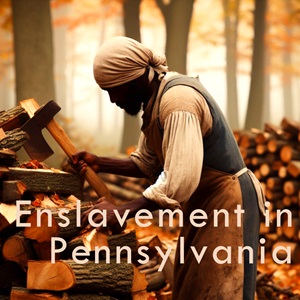
George Washington's Grist Mill in Fayette County, Pennsylvania
Background
The story of Ona Judge, the enslaved woman who escaped from President George Washington's residence in Philadelphia in 1796 is well known. Her escape angered Washington and his inability to recover her, despite knowing where she was, highlighted for him the weaknesses of the 1793 Fugitive Slave Act. Judge's existence in Philadelphia also illustrates how Washington, like other wealthy southern planters, traveled with and utilized their enslaved laborers in Pennsylvania.
George Washington made many trips to western Pennsylvania, as an officer in the French and Indian War and later as a surveyor, always accompanied by a number of his enslaved people from Virginia. He acquired land in southwestern Pennsylvania as a result of his military service and increased his land holdings there dramatically by buying up land from other veterans, many of them impoverished and in desparate need of money, at a fraction of the value.
In 1772, Washington received an offer from an acquaintance and Virginia neighbor, Gilbert Simpson, to form a partnership to settle and develop some of the western land. They decided the venture would be best accomplished at a spot near the Youghiogheny River that offered land suitable for crops and a fall that could be utilized for a grist mill. Simpson, a man of fewer resources than Washington, would manage the site and join the work crew, but it was Washington who would provide most of the supplies and money. Simpson proposed taking one of his own enslaved men as a worker and asked Washington to provide "one fellow and one wench."
London and Nancy
Although we do not know the name of the man enslaved by Gilbert Simpson that accompanied the party westward, we do know the names of the enslaved people sent by George Washington from Mount Vernon into the backcountry of western Pennsylvania. Washington, a cautious businessman, wished to be clear with his new parter, "in order that each may know he stands indebted to the other on acct. of the joint Concern." To that end he requested that fellow Virginian Craven Peyton inventory and appraise all of the tools, livestock, and other articles supplied by each of the partners in the venture. It is from this inventory that we have the names of the two enslaved people sent by Washington to settle the land and build the gristmill.
 In a February 1793 letter to Gilbert Simpson, Washington included a detailed list of everything that he provided, among all the tools, gear, wagons, livestock and sundries are listed " a negro man -- London," and "a negro girl -- Nancy." Both were notated as "to be appraised. The young man named London was not Washington's first choice to go. At that time he had about two hundred enslaved people. The man he initially chose, someone only recently purchased in Alexandria, refused to leave the Virginia plantation for the Pennsylvania wilderness, so in his stead Washington sent London, who was purchased from a seller in New England for £55. In his letter, Washington explained the switch to Simpson:
As the Negro Fellow I bought in Alexandria will by no means consent to leave this Neighbourhood and as you did not seem Inclind to take him without I have sent a young Fellow which I bought last Spring in his room. In coming from Boston here he got Frost Bit and lost part of his Toes which prevents his Walk'g with as much activity as he otherwise would but as they are quite well, and he a good tempered quiet Fellow I dare say he will answer the purpose very well.
On the girl Nancy, for whom Washington paid £47, 10 shillings, he wrote "I also send you a fine, healthy, likely young Girl which in a year or two more will be fit for any business, her principal employment hitherto has
been House Work but is able, or soon will be to do any thing else." This description implies that Nancy, the young girl sent to help settle a patch of wild frontier ground, was almost certainly a pre-teenaged child, perhaps as young as nine or ten years old. Enslaved children of that age were entrusted with simple household chores such as sweeping, washing, laundering, carrying water and firewood and tending to a fire. At about age twelve they were typically given heavier and more complicated house and farm chores, those duties that fell under the popular phrase "fit for any business." Nancy would not be old enough for that level of responsibility for one or two more years.
Settling the Land and Building the Mill
The party reached the nearly 1600 acre site on the Youghiogheny River in April of 1793. Letters from Gilbert Simpson to George Washington provide much of what we know about how the venture progressed. The first year was marked by illness from the difficult journey, personal problems for Simpson, as his wife did not want to move to the frontier, and Simpson's frequent requests to Washington for additional funds, supplies and laborers. It was not until May of 1774 that actual construction of the grist mill began. That year was marked by trouble with local Native Americans, however, and Simpson found it necessary to construct a "fort," or a stockaded house, next to his log house for protection from raids. He named it Fort Triall, as if to mark the partnership's frequent challenges.
Simpson asked for additional money for the mill in the months that followed, but was able to boast of good corn crops brought in by his family and enslaved laborers. Once the mill was built and operational, Simpson's fortunes improved. Within a few years his house became a frequent stopping place for travellers and he even supplied provisions to the Continental Army during the war. In May 1781, a bit more than eight years into the operation, he wrote to George Washington with an update on the settlement, now known as Washington's Bottom. Simpson reported that his family and all laborers "are in good helth and the negros and stock of every kind sems to incres fast." Washington's enslaved girl Nancy would have been of childbearing age by this time, probably somewhere between eighteen anbd nineteen years old, and it is very likely that some of the "increase" were children born to her.
Despite Simpson's statement in 1781 that "your mill has made you good profet within this year past," by February 1784 Washington had yet to receive any money from the venture and wrote a curt letter to Simpson demanding a full accounting of the operation so far. Simpson replied that April with a glowing report of a prosperous farm and mill, healthy increases in livestock, the addition of "six young slaves...and one more expected in a short time." Since Simpson had requested an additional enslaved man and woman from Washington some years earlier, although it is not clear if Washington sent any additional slaves, and as Simpson almost certainly brought an enslaved woman from this own household when his family joined him from Virginia, it is unlikely that all of the "six young slaves" were Nancy's children, but there are clues that the "expected" birth of an enslaved child that spring was hers.
The Partnership Collapses
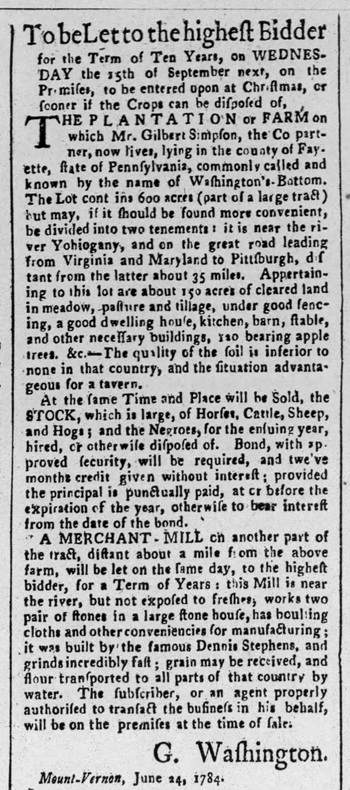
Not long after receiving Simpson's last letter, George Washington made plans to travel to western Pennsylvania to investigate not only his mill but also stories of squatters who had settled on his land nearby. Prior to the journey he made the decision to lease the mill and plantation on the Youghiogheny and sell all of his stock. His advertisement, published in the Pennsylvania Packet, offered to lease the mill for ten years and to sell by public auction on September 15 of that year all of the livestock, "and the Negroes, for the ensuing year, hired, or otherwise disposed of." In a pre-sale letter to Gilbert Simpson, Washington noted that the decision to sell all of the stock did not include "Negroes which may be necessary to finish the crop."
George Washington was at the settlement for the sale on September 15, 1784. He was somewhat disappointed that that they were unable to lease the gristmill, but was otherwise successful in selling off the "stock," which included the young children of the enslaved workers. He recorded in his personal journal:
This being the day appointed for the Sale of my moiety of the Copartnership Stock — many People were gathered (more out of curiosity I believe than from other motives) but no great Sale made. . . My Mill I could obtain no bid for . . .The Plantation on which Mr. Simpson lives rented well.
Nancy's Children
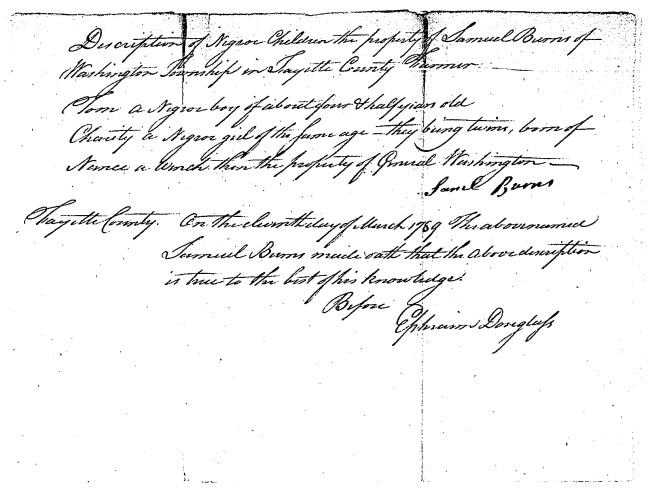
A township farmer, Samuel Burns, was at the sale and purchased two infant enslaved children, twins Tom and Charity. In March 1789, as required by Pennsylvania law, he traveled to the Fayette County prothonotary's office to officially register these enslaved children. Burns, a farmer, may have been illiterate or had such bad handwriting that his return was neatly written out by the county prothonotary, Ephraim Douglass, with Samuel Burns' signature appearing below his sworn statement in an obviously different hand. The return reads:
Description of Negroe Children the property of Samuel Burns of Washington Township in Fayette County Farmer --
Tom a Negroe boy of about four & half years old
Charity a Negroe girl of the same age -- they being twins, born of Nance a wench then the property of General Washington --
Samuel Burns
Fayette County. On the eleventh day of March 1789 the above named Samuel Burns made oath that the above description is true to the best of his knowledge.
Before Ephraim Douglass
Burns' household already held one enslaved worker, a woman born in 1777 named Susanah. It is this woman, registered as a slave for life in December 1782 by Burns, who would have the responsibility of raising enslaved newborn twins. Susanah would give birth to her own son, Peter, in August 1792, and was probably the mother of James, registered by Samuel Burns in April 1791, although the mother of James was not included on the return.
The fate of Nancy, mother of the twin children Tom and Charity, and that of London, is not certain. George Washington wanted all of his enslaved people connected to the Fayette County gristmill and plantation hired out to work the plantation or sold. The young children appear to have been sold. The man London presumably was kept to bring in the crop, and probably Nancy, who as a young woman in her early twenties could do field work. In fact it was Gilbert Simpson who acquired the lease on the farm, and who kept Washington's enslaved workers as hired help through October 1785, when Washington made arrangements to bring the enslaved workers originally part of the partnership back to Mount Vernon.
Sources
Cecil E. Goode, "Gilbert Simpson: Washington's Partner in Settling His Western Pennsylvania Lands," The Western Pennsylvania Historical Magazine, Vol. 62, Number 2, April 1979, pp. 149-166.
The Washington Papers, Center for Digital Editing, University of Virginia, "George Washington Financial Papers," Ledger B, 1772 - 1793: pg.87.
The Pennsylvania Packet and Daily Advertiser, 24 June 1784.
"Birth Records for Negroes and Mulattoes, 1788-1826," Fayette County, Pennnsylvania Prothonotary Records, RG-47 Birth Records for the County Governments, Pennsylania State Archives; Pennsylvania Historical and Museum Commission.
George D. Albert, editor, History of the County of Westmoreland, Pennsylvania (Philadelphia, 1882), page 447.
Fayette County Index Page | Enslavement Main Page | Afrolumens Project Home
|