 slavery
to
freedom


A series of pages exploring
various aspects of enslavement in Pennsylvania
Race, Bondage, Women and Children
A Dutch Woman and Child for Sale, 1759
Bound for Seven Years
News item from The Pennsylvania Gazette, Philadelphia, March 1759
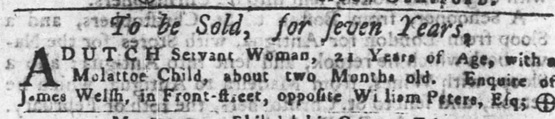
To be Sold, for seven Years, A DUTCH Servant Woman, 21 Years of Age, with a Molattoe child, about two Months old. Enquire of James Welsh, in Front-street, opposite William Peters, Esq.
Notes: With regard to this child's bound status, colonial law typically held that a child inherited the bound status of its mother. Although the mother was bound to servitude for seven years, she was still legally considered a free woman, which meant her child would ordinarily have been considered born free and her child owed no service to her master from that condition. However, by having a child out of wedlock she was guilty of the crime of bastardy and her child would then typically be bound out to serve until at least their teenage years and more likely until age 21 to compensate their master for care and upbringing.
Complicating this situation, her child was not white. In Pennsylvania, Maryland and Virginia, a child of mixed race born to an enslaved, free or bound white mother was itself enslaved to age 31. Pennsylvania laws changed in 1780 and 1788, removing forced servitude for mixed race children born to free white mothers, although orphan's courts still bound out indigent children of all races.
Given the likelihood that a court would bind the child to the master for considerably more than seven years, the term of service owed by the Dutch woman advertised for sale, consider her situation at the end of her term of servitude. Her seven-year-old child would still be bound for many more years in that household. Would she be able to stay in order to remain with her small child? What type of agreement or additional indenture would have to be worked out with her child's master? In facing this situation, she would likely find her freedom compromised for many years to come.
Source: The Pennsylvania Gazette, 08 March 1759.