 slavery
to
freedom


A series of pages exploring
various aspects of enslavement in Pennsylvania
Race, Bondage, Women and Children
Children with Vitiligo Exhibited as a Public Curiosity
Disease Causes a Loss of Melanin in Patches of Skin
News item from The Pennsylvania Journal or Weekly Advertiser, Philadelphia, July 1784
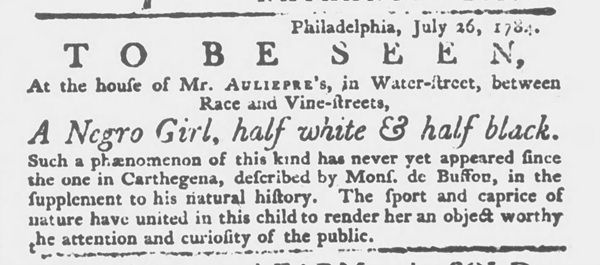
Philadelphia, July 26, 1784.Two days later a meeting notice for the American Philosophical Society appeared in another Philadelphia newspaper announcing an exhibition at the meeting of what must have been this same child, as well as another not mentioned in the first ad:
TO BE SEEN,
AT the house of Mr. AULIEPRE's, in Water-street, between Race and Vine-streets,
A Negro Girl, half white & half black.
Such a phaenomenon of this kind has never yet appeared since the one in Carthegena, described by Mons. de Buffon, in the supplement to his natural history. The sport and caprice of nature have united in this child to render her an object worthy the attention and curiosity of the public.
A special meeting of the American Philosophical Society will be held at the University, next Friday evening, at six o'clock; at which time will be submitted to the inspection of the Members of the Society a Lusus Naturae of a most extraordinary kind, the property of Monsieur Valois, a gentleman of France, lately arrived from St. Domingo, viz. A negro child, chiefly of a very black colour, but having in several parts, of great extent, a very white skin, in some parts spotted like a leopard, with curious marks resembling constellations. Also, a mulatto child, in some parts white, in others spotted. The intention of this exhibition is to satisfy the curiosity of the learned, and to afford them an opportunity of comparing sentiments on the nature and causes of such extraordinary phenomena.The APS announcement billed the exhibit as a "lusus naturae," Latin for freak of nature. A further description of the child compared its appearance to an animal ("spotted like a leopard") and in mystical terms ("curious marks resmebling constellations"). The two children, slaves of Monsieur Valois, were never described in any terms acknowledging their humanity, but merely as spectacles "to satisfy the curiosity of the learned."
R. PATTERSON, Secretary.
By order of the Revd. Dr. W. White, Vice President.
July, 28, 1784.
Such fascination with skin color, or the lack thereof, in enslaved people was not new. In 1743 The Pennsylvania Gazette published the following item:
The following remarkable Advertisement is taken from the South Carolina Gazette, May 30.The child mentioned in this older advertisement may have had albinism, a condition not unknown at the time, but often associated with persons of color. As with the later children exhibited in Philadelphia, this article was meant to arouse curiosity in readers.
To be shewn, at 5s. each Person (about 1s. Currency) For the Space of one Week from the 2d Tuesday in June next, at the House of Mr. Joel Pointlet in Charlestown, a WHITE Negro Girl, of Negro Parents; she is as white as any European, has a lively Blush in her Countenance, grey Eyes continually trembling, and Hair frizzled as the Wool of a white Lamb.
Sources: The Pennsylvania Gazette, 23 June 1743; The Pennsylvania Journal or Weekly Advertiser, 28 July 1784; The Freeman's Journal, or The North American Intelligencer, 28 July 1784.